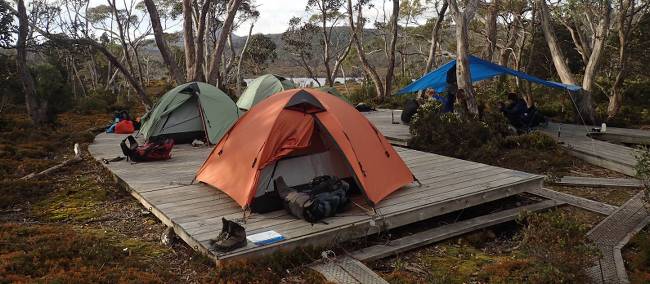
Camp setup on the Overland Track
Check out our top ten camping hacks, guaranteed to make your next overnight camping trip a breeze!
Make your own pillow
When going on a full pack adventure, every inch of space counts. This means that carrying a pillow to rest your weary head can take up a lot of your much needed space in your pack. Instead of packing a pillow, simply bring a pillowcase and stuff it with your clothes. It’s cheaper than buying a blow up pillow, and the pillowcase even serves as an additional bag if required to help organize your gear when packing.
Turn your headlamp into a lantern
Most of our favourite camping hacks are about how to minimize space and make the most out of what you bring. So when it comes to headlamps, it’s no different! When the sun sets and light gets dim, simply wrap your headlamp around a plastic water bottle with the light facing in! This creates a soft glow that can be perfect for reading, writing or simply illuminating the area around you.

Bring microfibre towels
Here’s an essential item you simply can’t do without! Mircofibre towels are incredibly lightweight and absorbent, which means you don’t have to worry about lengthy drying times as you would with normal towels. They are compact, and will usually fit into the nooks and crannies of your backpack, and can hang on the outside of your pack while walking if you want to dry them during the day. Ditch your standard bathroom towels and you’ll save inches in your backpack!
Sleep with your shoes
When you’re heading to colder climates, like Tasmania, where an evening frost is common, some of our most experienced guides have shared a little secret that can save you from putting on frozen shoes in the morning. Sleeping with your shoes! Simply slip your shoes in a ziplock bag, ensure that it’s closed, roll it tight and sleep with them in the foot of your sleeping bag. While it might sound odd, it’s worth it! When temperatures drop to below zero in Tasmania around certain times of the year (mainly winter, though it’s not uncommon to see snow in summer), keeping your shoes outside the tent in the cold night air can freeze your shoes – especially if they’re already wet. Sleeping with your shoes tucked neatly in your sleeping bag will ensure the body heat keeps your shoes from freezing overnight.
How to estimate daylight
Here’s a nifty trick they don’t teach you in school. Next time you want to estimate how many hours of sunlight is left, simply extend your arm and align the top of your index finger with the bottom of the sun. Each finger between the sun and the horizon indicates about 15 minutes of daylight. Of course, this is a guide only and you may find that depending on your location in the world, this technique may or may not apply. Visiting Alaska? It’s not likely this technique will work during summer when there is sunlight for almost 24 hours in the day! Additionally, the closer you get to the equator, the faster the sun will set based on the finger measurements.

Packing duct tape efficiently
It’s difficult to deny the handiness of duct tape on a trek. This multi-purpose trekking essential can help tape up feet when blister hot-spots are detected, mend dodgy boots or equipment, keep food bags closed, waterproof gear, patch ripped clothing … the uses go on! Instead of packing an entire roll of duct tape in your bag, simply wrap a foot or two around your water bottle, flashlight or lighter and you’ll have some easily accessible tape handy at all times.

Dry your shoes with newspaper
While time is your best friend when it comes to drying your soggy trekking shoes out, the next best thing is a newspaper! If you want to speed up drying your inner shoes after your trek, simply scrunch newspaper into loose balls and stuff your shoes with it. The newspaper fibres will help absorb moisture quickly. If your shoes are wet on the outside, you can even wrap the outside of your shoes in newspaper. You’d be surprised how well this works for removing moisture – and it’s much better for your shoes than taking them home and putting them in the dryer.

Use a checklist
When you’re planning your trek, nothing can make you feel more overwhelmed about packing for your trip than a lack of order. A checklist is an all-important necessity when it comes to packing for your trip – in fact, we believe in checklists so much that on almost every trip you go on, you will be provided with a packing list to ensure you have all your gear. Following checklists can ensure you don’t forget small (but essential) items that are sometimes easily forgotten, such as bandaids, toothpaste, spare batteries for your head torch, or even items like sunglasses!
Treating mosquito bites
While you may have doused yourself in mosquito repellent, sometimes you just can’t avoid getting bitten on the trail by persistent mosquitoes. If you’ve got an itch you just can’t scratch, try putting some deodorant directly onto the bite. You’ll find that the aluminium present in the deodorant acts as an astringent and minimises the itch of your mosquito bite!
Compactor bags as a liner
If you’re heading anywhere that can have variable or uncertain weather, where rain is potentially on the forecast, it’s worthwhile considering using a compactor bag as a liner within your pack. This can give an added bit of protection from the wet – and for a small investment, the peace of mind is worth it!
Forget “Just in case”
The best way to have a great trek is to keep your trekking pack light and leave unnecessary things behind. And a sure-fire way to do this is to rid the words “just in case” from your vocabulary! While we think that planning for all types of weather and temperatures is important, if you’re thinking of bringing an extra deck of cards “just in case” you lose a card from your first set, or carrying an extra pair of sandals “just in case” the ones you have already packed don’t go with your camp clothes, then please take our advice, and leave those items behind.
Inspired?
Visit out website to browse our trips and start planning your next adventure today